The Ocean Doesn’t Ask for Much. So Why Do We Give It So Little?
“We protect what we know. We care for what we love.”
There is something strange about the ocean.
It covers more than seventy percent of our planet.
It regulates the climate that allows us to live.
It produces much of the oxygen we breathe.
It feeds billions of people.
It absorbs the excess heat created by our changing climate.
And yet, for something so vast, so generous, and so essential, it asks remarkably little of us.
It doesn’t send reminders.
It doesn’t knock on our doors.
It doesn’t organise fundraising dinners or television appeals.
The ocean simply continues.
Every morning, the tide arrives whether anyone is watching or not.
I often think that’s part of the problem.
From the shore, it appears endless.
Resilient.
Untouchable.
We stand on the beach and watch waves rolling towards us exactly as they did yesterday, and the day before that, and the year before that.
It’s easy to believe everything beneath the surface is just as constant.
But it isn’t.
Much of what is changing is happening somewhere we rarely see.
Coral reefs bleaching beneath warm water.
Seagrass meadows quietly disappearing.
Marine species adapting—or failing to adapt—to rapidly changing oceans.
The sea doesn’t always show us its wounds.
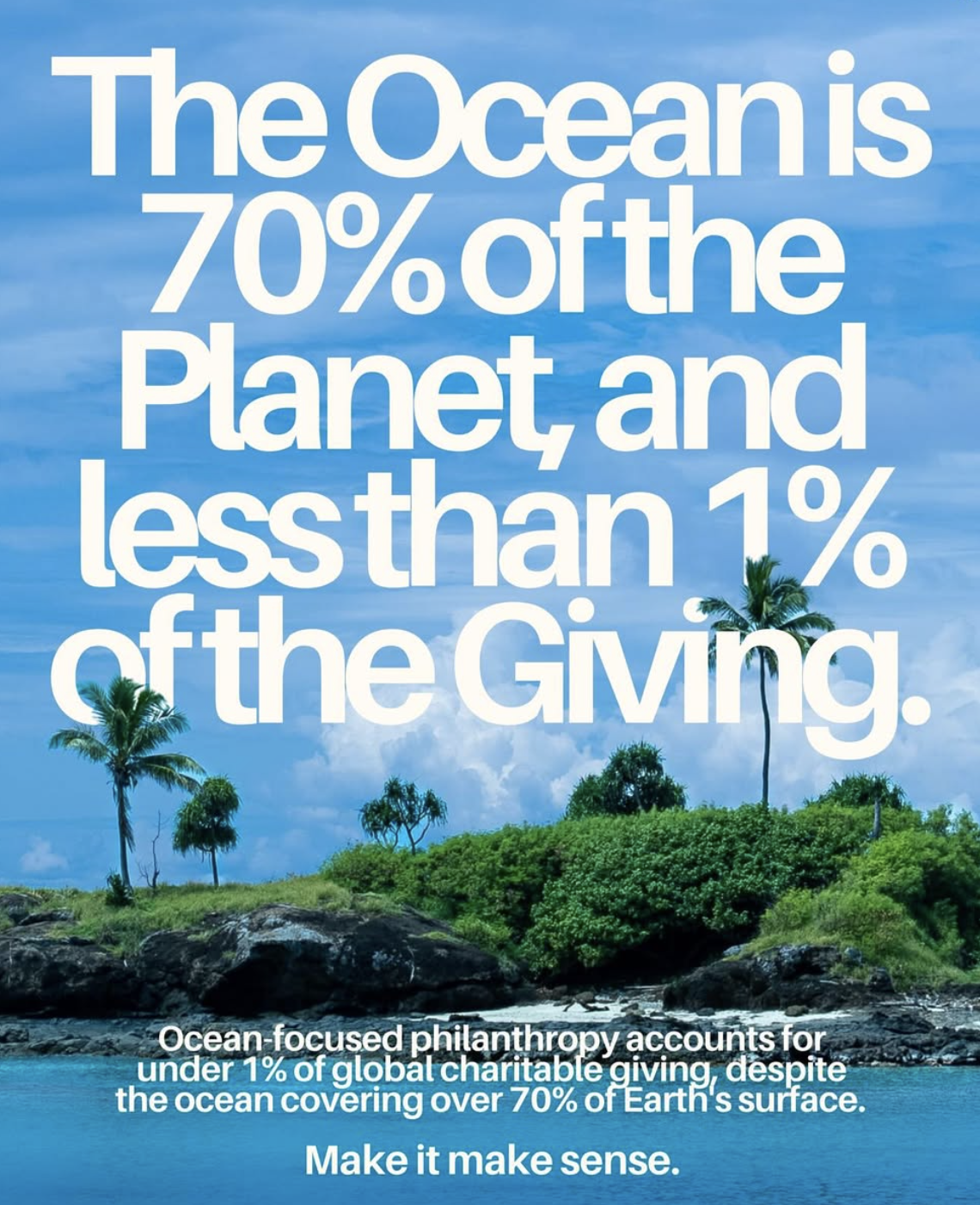
Image sourced from Counting Coral
A few days ago, I came across a statistic that stopped me in my tracks.
The ocean covers more than 70% of Earth’s surface.
Yet less than 1% of charitable giving is directed towards ocean-focused causes.
I read it twice.
Then a third time.
Because surely something that sustains every life on this planet couldn’t receive such a tiny fraction of our collective generosity.
But it does.
According to recent giving data shared by Counting Coral, environmental and animal causes receive only a small share of charitable donations, while ocean-specific giving represents an even smaller slice. It’s a crazy imbalance for the very system that helps make life on Earth possible.
Not because people don’t care.
I think it’s because people don’t realise.
When disaster strikes on land, we see it.
We see homes underwater.
Burnt forests.
Animals needing rescue.
Families rebuilding.
Our compassion has somewhere immediate to go.
The ocean tells its stories differently.
It’s struggles happening beneath the surface.
Invisible problems are difficult to prioritise.
Not because they’re less important.
Because they’re easier to overlook.
The irony is that many of the organisations protecting our oceans aren’t asking for millions from a handful of people.
They’re asking for thousands of people to give what they can.
A monthly donation.
A shared story.
A conversation.
A decision to care.
Conservation has never been about one hero saving the sea.
It’s about millions of ordinary people deciding the ocean matters.
I’ve spent the last few years learning from the ocean, documentaries, conversations and stories from people whose lives revolve around the water.
One thing has become clear.
Hope isn’t something we find.
It’s something we build.
Coral reefs are being restored.
Seagrass is being replanted.
Protected marine areas are recovering.
Species are returning where communities have chosen to act.
These aren’t distant dreams.
They’re happening now.
They just need way more people standing behind them.
Sometimes we think generosity only counts when it’s grand.
But what if protecting the ocean looked different?
Or choosing one organisation whose work you believe in and helping them continue it.
Or sharing their work with someone who has never heard of them before.
Where to Start
If this article has stayed with you, I’d encourage you to choose one ocean organisation today.
Not ten.
One.
Read about their work.
Follow their journey.
If you’re able, consider becoming a monthly donor.
Reliable monthly giving allows organisations to plan long-term research, restore habitats, support people in the field, and continue to rebuild the ocean.
Organisations Making a Difference
Rather than trying to support everyone, start with one organisation whose mission resonates with you. Here are a few doing important work around the world:
Counting Coral — Restoring coral reefs through propagating coral species that are genetically resilient and planting them on sculptural installations.
SeaLegacy— Using storytelling and photography to inspire ocean protection.
The Ocean Cleanup — Developing technologies to remove plastic pollution from oceans and rivers.
Mission Blue — Protecting critical marine ecosystems known as Hope Spots.
Surfrider Foundation — Protecting coastlines and ocean access through grassroots action.
Choose one.
Learn their story.
Become part of it.
In case you’re wondering, I’m choosing to support Counting Coral in any way I can, read why here.